
Where to find it, when to view it, and how it appears – as explained by a fumbling newbie
By April Ryan | Published: Sunday, September 5, 2021
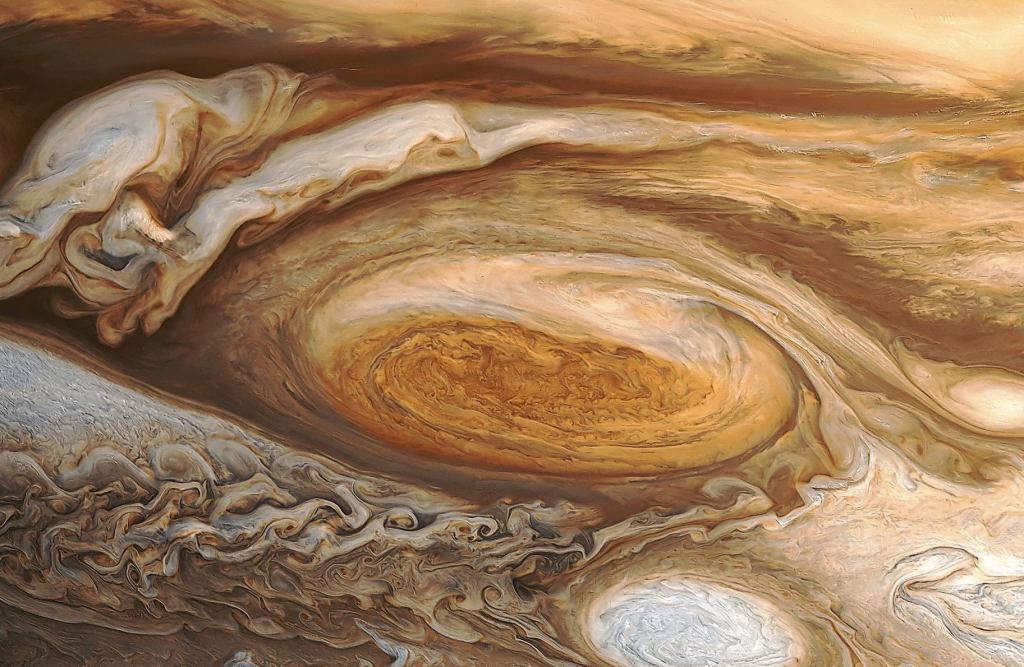
— Johannes Kepler
Image Credit: NASA
I was up relatively late reading the August 2021 issue of Astronomy Magazine, when I came across an article entitled Explore the Wonders or Jupiter. Now, mind you, I was reading this on August 20th, even though I received the issue back in July because I never seem to be caught up, even on my hobbies. The article mentioned that Jupiter’s opposition was on August 19th. To which, I promptly let out a string of expletives having missed the event the night before. Upon sober reflection, however, I concluded that a) last night was cloudy with little-to-no clear sky views, and b) the night after opposition is just as good as the night of – I mean, it takes Jupiter 11.8618 Earth years to complete a single orbit of the Sun – how far could it have moved in a 24-hour period? No seriously, how far? Comment below if you know the answer.
After the panic subsided, I ran outside and noted with satisfaction that the skies were clear, so I proceeded to pretend that I had planned it this way. I can do that because, you know, it’s my blog. I continued to read through the article as it expounded on all of the wonders that can be seen on Jupiter: The Great Red Spot, The Little Red Spot, Clyde’s Spot, the Equatorial Region, the Northern Tropical Regions, etc. Optimistically, I dragged out my telescope (a 5.11″ Newtonian Reflector), and laughed wryly at how little detail I could make out, even when applying my high-power, 10mm eyepiece to the old Barlow my father gave me along with his 55-year-old Edmonds Edscorp 6″ Newtonian Reflecting Telescope (yes, I know, I know. I need to upgrade my Barlow). But, I resolved that at the very least maybe I could make out the Great Red Spot. I mean, the Great Red Spot can fit over 3 Earths inside of it, it’s HUGE, how hard could it be? Google sent me to Sky and Telescope Magazine’s transit time calculator which is a very handy reference for when to look for the monster storm’s appearance at the central meridian.
That evening it would be visible at 3 a.m. It was, at the time, 11:30 p.m. Oh, joy. The dilemma I was faced with was to either stay up and catch my first glimpse of this glorious behemoth, or try again a different evening at a less circadian-rhythm-disrupting time of night. Given the hurricane weather that had been plaguing Charlotte, NC’s night skies this summer, I opted to go the distance on this auspicious evening. It takes Jupiter 9 hours, 55 minutes, and 30 seconds to rotate on its axis, to be pedantically precise. Therefore, I should be able to see the Spot – let’s see, 10 divided by 2 is 5, divided by 2 again is 2.5 – so, roughly two hours before and two hours after it lines up on the central meridian, right?
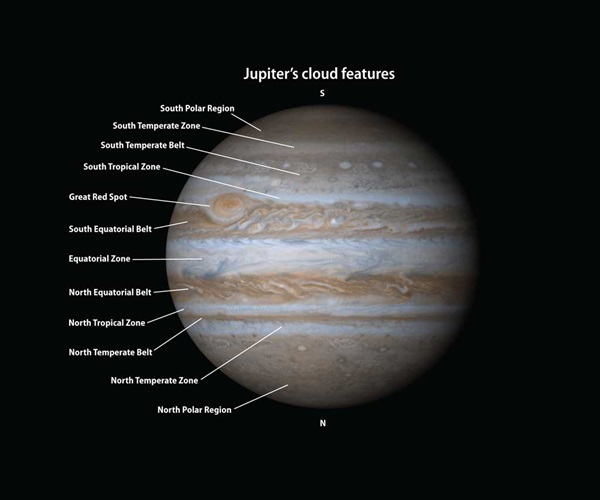
Wrong. Picture me, cozied up in bed with my science articles and my dog, Luna, popping up every 10 to 20 minutes or so to see if I could spot “the Spot” (pun intended), something I have never even located before. I had no cues or reference points other than its position in one of the planet’s bands in the southern hemisphere. After some sleuthing on the interwebs, as well as discerning that my telescope inverts the images I’m viewing (see picture above for how Jupiter appears from my perspective when viewed through my telescope), I was able to figure out approximately where I should be searching. So, I searched. I searched at one in the morning. I searched again at half past one. I returned at intervals, time and time again, with no joy. That scrappy lil’ dust devil didn’t deign to make an appearance until 2:30 a.m., at least as far as I could discern. Bleary-eyed, but alight with excitement, I finally found the bugger. Upon which I looked at it, looked at it again, then put my scope up and gratefully went to bed.
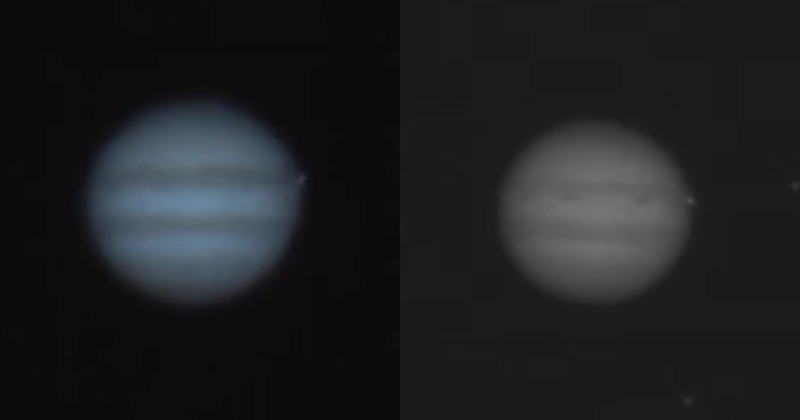
Finding the Great Red Spot is more about locating how it disturbs the cloud patterns around it, rather than locating the spot itself. To me, Jupiter looked much the way it does in the images above. Without color filters the Great Red Spot is not-so-red. It appears as an absence, a white void. The tan band where the storm appears belies its location by outlining it, and when you finally see it, you can’t “unsee” it. Now I look at Jupiter without checking the transit calculator to test myself. Only after I think I have found it do I then cross-reference the website to see if it is, in fact, observable. So far, I’m always spot on! It’s usually only readily available for viewing with a small telescope for about 30 minutes before and after it lines up with center. This amounts to one hour roughly two times an Earth day, and one of those transits happens when the sun is out, obscuring the view.
I have shown the Great Red Spot, through my prized-by-me telescope, to visitors unfortunate enough to be at my house in the evening time. It never fails to impress. So, happy hunting! I do hope my misadventures help you on your way to observing a storm that has been raging on Jupiter for, at the very least, 356 years or more.
 The Night Sky & I
Love this web page. Excellent article!
LikeLiked by 1 person
I am the author’s Father. In my 50 plus years as a amateur astronomy, I never thought to try to see the Great Red Spot. This article by my daughter inspired me to seek it out with my new Celestron 9.25 Evolution. Using the transit time calculator discussed in the article above, I found that it would be visible at 10 pm in three nights (I chose not to stay up until 3 am as my daughter did on her first red spot viewing adventure). At first, I could not locate it with my 40mm low power, but after adding my barlow at a higher power 26mm lens it was quite visible to both my wife and I. Thanks April for a very thrilling evening.
LikeLiked by 1 person
Thanks, Dad. You and Mom are the reason I got into astronomy in the first place! So, thanks for that as well.
LikeLike
Delightful article. I am glad that your Dad now has some one as passionate as you to share his interest in Astronomy. I enjoy looking with him but you are more invested than I and it fuels his interest to new heights.
LikeLiked by 1 person
Thanks, Mom! Y’all are my biggest fans!
LikeLike
Great article! Well written and easy to follow. I have spent most of my adult life looking at the ground to determine what I can plant there. April has inspired me to look up to see what I can discover there. Maybe I have found a new hobby?!?
LikeLiked by 1 person
Just let me know! I’d be happy to recommend some beginner telescopes.
LikeLike